
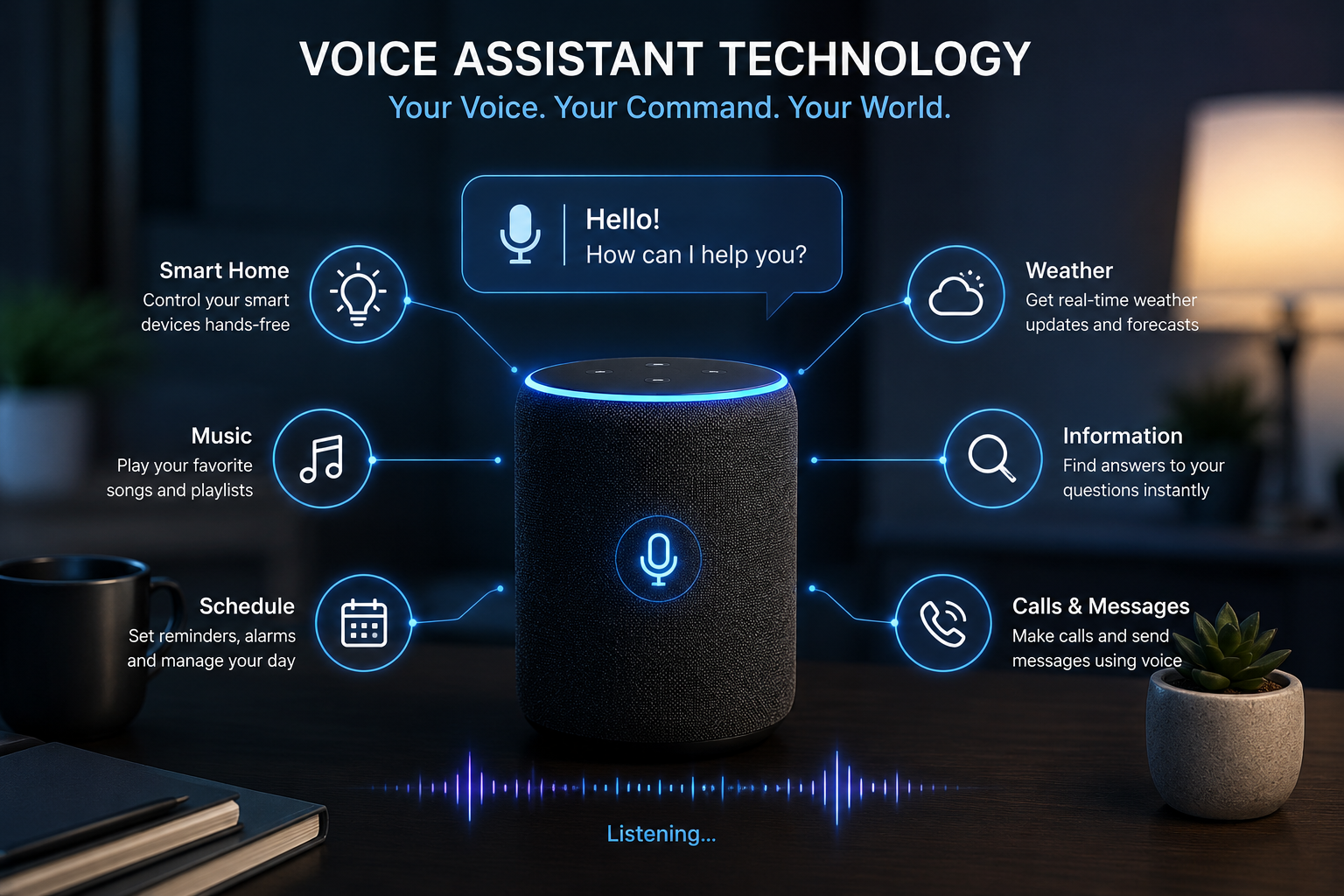
Voice Assistant Technology: How Smart Products Are Replacing Effort, Educating Customers, and Reshaping the Future of Electronics
The salesperson who never sleeps. The product guide that never forgets a specification. The customer support agent who speaks every language — instantly. This is not a distant vision. It is what voice assistant technology is delivering right now, and the companies embedding it into their products today are the ones who will lead tomorrow.
The Shift Is Already Happening — Are Your Products Ready?
In 2024, over 8.4 billion voice-enabled devices were in active use globally. By 2028, analysts project that more than 55% of all household electronic devices will incorporate some form of voice interaction layer. The shift from button-based and screen-tap interfaces to natural language commands is not a trend — it is the next fundamental design paradigm for consumer and commercial electronics.
But voice assistant technology is no longer only about convenience. For product manufacturers and electronics companies, the deeper opportunity lies in what voice can do for the entire customer journey — from first discovery and product briefing, all the way to post-purchase guidance and long-term engagement. When a customer can simply ask a product what it does, how it works, and which configuration is right for them, the gap between interest and confident purchase closes dramatically.
At Epsilon Electronics, we have already embedded voice assistant intelligence into product briefing and specification guidance systems — effectively enabling the product itself to become a knowledgeable, patient, and always-accurate sales companion. Here is a deep dive into why this matters, which industries are moving fastest, and what the near-future of voice-enabled products looks like.
What Is Voice Assistance Technology in the Context of Smart Products?
Voice assistant technology, at its core, combines Natural Language Processing (NLP), speech recognition, and contextual response engines to allow users to interact with a device using spoken commands and questions — in plain, everyday language.
In a product context, this means a customer standing in front of an air conditioning unit, a medical device, an industrial control panel, or a retail kiosk can say “What cooling modes does this support?” or “Show me the energy consumption for 8 hours of use” — and receive an accurate, conversational answer without scrolling through a manual, waiting for a sales rep, or navigating a complex touchscreen menu.
Modern voice assistant integrations in electronics work across three deployment models:
- Cloud-connected processing — commands sent to remote servers for processing; ideal for rich, conversational AI with large knowledge bases
- Edge/on-device processing — voice processed locally on the hardware; preferred for privacy-sensitive environments, offline use, and low-latency responses
- Hybrid architecture — routine commands handled on-device, with complex queries escalated to cloud AI; the emerging standard for commercial-grade deployments
For product manufacturers, the choice of architecture shapes everything from hardware design to data security compliance — and getting this right from the start is where experienced embedded electronics partners like Epsilon Electronics make the critical difference.
Six High-Impact Industries Adopting Voice Assistant Technology Right Now
1. Consumer Home Appliances & Smart Home Ecosystems
This is the most visible frontier. Smart ACs, refrigerators, washing machines, and security systems with embedded voice control are no longer premium novelties — they are becoming table stakes for mid-to-premium segment products. But the more compelling innovation is voice-guided setup and diagnostics.
Rather than a customer calling a helpline to understand why their smart thermostat is behaving unexpectedly, a voice-enabled device can walk them through a self-diagnosis — asking a series of guided questions, cross-referencing configuration states, and delivering a resolution or escalation path, all in real time. This dramatically reduces after-sales support costs while improving customer satisfaction scores.
The near-future implementation here is proactive voice notifications — appliances that do not wait to be asked, but volunteer relevant information: “Your filter requires cleaning in approximately 3 days based on current usage patterns.” Products that speak first build trust and dramatically improve perceived quality.
2. Retail Electronics & In-Store Product Kiosks
This is where Epsilon Electronics has developed significant hands-on expertise. In a retail environment, the gap between a customer’s question and the availability of accurate, detailed product information is enormous. Sales teams cannot be everywhere. Brochures go unread. Specification comparison across product variants is cognitively demanding.
Voice-enabled product briefing kiosks close this gap entirely. A customer approaches a display unit and asks: “What is the difference between the 1.5-ton and 2-ton model for a 200 sq ft room?” The system responds with a tailored comparison — factoring in room size inputs, energy efficiency ratings, and usage scenarios — just as a well-trained product specialist would.
The impact is measurable: shorter decision cycles, higher conversion rates, and fewer post-purchase returns driven by misaligned expectations. For electronics manufacturers and retailers, this is a direct revenue and margin lever.
The near-future extension of this is multilingual voice assistance — critical for a market like India, where Hindi, Gujarati, Tamil, Marathi, and dozens of other languages represent majority-customer demographics. A product kiosk in Gujarat that can brief a customer fluently in Gujarati is not a feature. It is a competitive advantage that no printed brochure can replicate.
3. Healthcare & Medical Devices
Healthcare is one of the most transformative — and responsibility-laden — applications of voice assistant technology. The opportunity spans two distinct directions.
The first is patient-facing voice interaction: wearable health monitors, home diagnostic devices, and medication dispensers that can confirm correct usage, remind patients of schedules, and escalate anomalies by voice. For elderly users and patients managing chronic conditions, the reduction in friction between device and understanding is not just a UX improvement — it is a meaningful health outcome.
The second direction is clinical and professional environments: voice-controlled imaging equipment, surgical assist systems, and patient data entry tools that allow healthcare professionals to operate devices without breaking sterile protocols. Near-future implementations will see voice-enabled home health devices become standard components of remote patient monitoring programs.
4. Industrial Manufacturing & Workplace Operations
In a factory or warehouse environment, the hands-free nature of voice control is not a convenience — it is a fundamental operational upgrade. Workers operating on assembly lines, managing inventory, or performing equipment maintenance need both hands available at all times.
Voice-enabled maintenance logging allows a technician to verbally record an inspection finding, trigger a work order, or check a part specification without stopping work, removing gloves, or locating a terminal. Voice-guided assembly assistance can walk a new worker through a complex procedure step by step, reducing onboarding time and error rates simultaneously.
The near-future for industrial voice integration is tight coupling with IoT sensor networks — where a voice command triggers not just a software action but a physical response from connected machinery, creating a seamlessly orchestrated human-machine workflow.
5. Automotive Electronics & In-Cabin Systems
The automotive sector was an early adopter of voice control, but early implementations — rigid command structures, poor accent handling, limited contextual awareness — created widespread skepticism. The new generation of embedded automotive voice assistants is categorically different.
Modern in-cabin voice systems built on advanced NLP can handle natural, conversational queries: “Find a charging station near my next stop that is open after 8 PM and has a fast charger.” They integrate with navigation, entertainment, climate, vehicle diagnostics, and communication systems simultaneously, and they learn individual driver preferences over time. For electronics suppliers to the automotive industry, voice interface integration is increasingly an OEM specification requirement rather than an optional upgrade.
6. Education Technology & Training Devices
EdTech hardware — classroom devices, language learning tools, interactive children’s educational products — represents one of the most scalable applications for voice assistant integration. A voice-interactive learning device can assess a student’s comprehension in real time, adapt its instructional approach to individual learning pace, and provide immediate feedback in a way that no static digital content can match.
For professional training environments, voice-enabled simulation devices allow trainees to practice procedures verbally — from emergency response protocols to equipment operation sequences — in a risk-free, measurable format.
How Voice Assistance Directly Reduces Human Effort Across the Value Chain
The phrase “reducing human effort” can sound abstract until you map it against specific cost and quality dimensions:
- For sales and pre-sales teams: A voice-enabled product can handle the majority of specification queries, comparison requests, and suitability questions without any human involvement. This elevates salespeople by removing repetitive, low-value interactions and freeing them for consultative, relationship-building conversations.
- For customer support: The most common post-purchase contacts are usage questions that the product should be able to answer itself. Voice-embedded product knowledge bases, updated remotely, can handle these queries at zero marginal cost with zero hold time.
- For onboarding and training: New product users — whether consumers or industrial operators — traditionally require significant hand-holding. Voice-guided onboarding walks users through setup, configuration, and best practices at their own pace, in their own language, without requiring human facilitators.
- For documentation and compliance: In regulated industries, voice-logged activity records are increasingly accepted as valid compliance documentation — replacing manual data entry with spoken reports that are transcribed, timestamped, and stored automatically.
Making Your Customer Smarter: Voice as a Product Education Engine
Perhaps the most underappreciated strategic value of voice assistant integration is what it does for customer knowledge and product confidence.
An informed customer is a loyal customer. A customer who fully understands what their product does, why it performs the way it does, and how to get the most from it is less likely to return it, less likely to generate support costs, and far more likely to purchase the next product from the same brand.
Voice assistants embedded in products can serve as continuous product educators — not just answering questions in the moment of setup, but offering contextual tips based on usage patterns, alerting users to features they have not yet discovered, and guiding them toward configurations that genuinely improve their experience.
This is the intelligence layer that transforms a product from a static object into a dynamic relationship between customer and brand. It is the difference between a product that is sold once and one that earns trust continuously.
Why This Is the Right Moment to Act
Three converging forces have made 2025 and the years immediately ahead the optimal window for product manufacturers to integrate voice assistant capabilities:
- Maturity of NLP technology: The accuracy, contextual understanding, and multilingual capability of modern voice AI has crossed the threshold where it is reliably good enough for commercial deployment — including in noisy environments and with diverse accents.
- Cost reduction in voice hardware: Wake-word detection chipsets, embedded microphone arrays, and on-device inference processors have dropped dramatically in cost, making voice integration viable at mid-market and even entry-level product price points.
- Customer expectation shift: A generation of consumers who have grown up with voice assistants now expects voice interaction as a default product capability. Brands that do not offer it are increasingly perceived as dated — not neutral.
The competitive window for differentiation through voice integration will narrow. Early movers will establish user experience benchmarks and brand associations with intelligent products that late entrants will find difficult to displace.
Epsilon Electronics: Your Partner for Voice-Integrated Product Development
At Epsilon Electronics, we have moved beyond theory. We are already designing and deploying voice assistant systems that serve as intelligent product briefing and specification guidance tools — empowering customers with the knowledge they need to make confident decisions, while reducing the dependency on sales team availability and consistency.
Our expertise spans embedded hardware design, NLP integration, multilingual voice model configuration, and cloud-to-edge deployment architecture. Whether you are designing a new product category from the ground up or retrofitting voice intelligence into an existing product line, we bring the full-stack capability to make it real — on specification, on timeline, and built for the Indian market.